The Hidden Cost of OEM Contracts
June 15, 2026
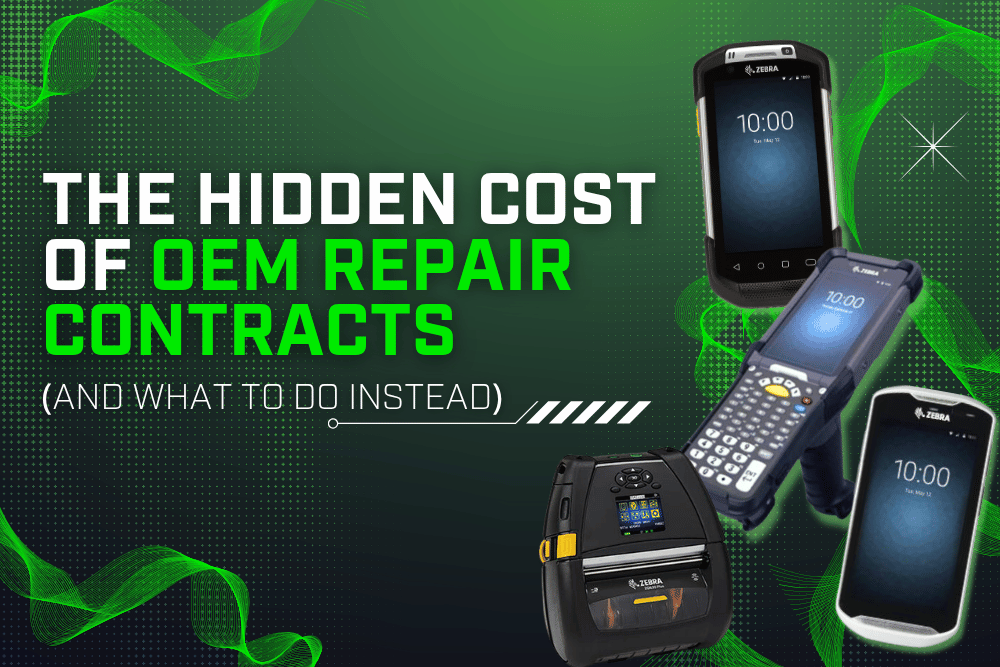
The Hidden Cost of OEM Repair Contracts (And What to Do Instead)
You signed the OEM service agreement because it felt like the safe choice. The manufacturer knows their hardware best, the contract looked comprehensive, and getting sign-off was easy because it came bundled with the original equipment purchase.
But if you're managing IT hardware across dozens — or hundreds — of locations, that "safe choice" may be quietly draining your budget and slowing your operations in ways that don't show up on a single line item.
Here's what OEM repair contracts actually cost, and what a smarter alternative looks like.
What You're Actually Paying For
OEM service agreements are priced to protect manufacturer margins, not your budget. The markup on parts, labor, and logistics is significant — and it's baked into the contract price before you've sent in a single device.
A few things worth understanding:
You're paying for the brand, not just the repair. Manufacturer service centers carry the overhead of a large organization — corporate facilities, tiered support structures, and warranty administration systems. You fund all of that every time a scanner, mobile computer or printer goes in for repair.
Parts markups are substantial. OEM contracts typically price replacement parts at full retail or above. Third-party repair providers source the same OEM-spec components at significantly lower cost — savings that flow directly back to you.
You're locked into their timeline. Standard OEM repair cycles can take 30 days or more. You can contract with them for faster turnaround times, but the cost for that sort of service with manufacturers is crazy high!
The Turnaround Problem Is Bigger Than It Looks
For a single-location business, a device out for repair is a nuisance. For multi-locations , it's a math problem — and the numbers add up fast.
Say you operate 150 locations, and each carries 20 handheld scanners. A modest 5% failure rate means 150 devices out at any given time. If each device takes 15 business days to return under an OEM contract, you're constantly managing a pool of offline hardware that should be working.
The operational cost of that downtime — workarounds, reduced scanning throughput, manual processes, IT time spent tracking status — rarely appears on the repair contract invoice. But it's real, and it's recurring.
A Note on Manufacturer Warranties
OEM contracts tend to look cost-effective in year one. The problems compound over time.
As hardware ages out of the manufacturer's "preferred" support window, OEM service pricing often increases while parts availability decreases. You may find yourself paying a premium for slower service on older devices — the exact opposite of what an aging fleet needs.
OEMs also have a natural incentive to recommend replacement over repair. If your contract is with the same manufacturer that sells the replacement hardware, their guidance on "end of life" isn't always aligned with your actual cost interests.
What a Third-Party Depot Repair Partner Does Differently
A manufacturer-agnostic depot repair provider doesn't have any of those conflicts. Their business depends on fixing your hardware quickly and cost-effectively — that's the entire value proposition.
Here's what that difference looks like in practice:
Faster turnarounds. Dedicated depot repair operations are built for speed. At Mercom, most repairs turn around in 3 to 7 business days — a fraction of typical OEM timelines.
Lower per-unit costs. Without the OEM markup on parts and overhead, per-repair costs are substantially lower. That difference is especially pronounced in high-volume fleets, where even modest per-device savings compound significantly.
Multi-brand support. Your barcode fleet probably includes hardware from Zebra, Honeywell, Datalogic, and other manufacturers. A third-party provider handles it all under a single relationship and invoice — no juggling multiple vendor portals or contracts.
Spare pool management. Rather than waiting for a repair to be completed before restoring a location's hardware, many depot partners (including Mercom) offer spare-pool programs. Good hardware ships to your location immediately, while the broken device is repaired and returned to inventory. Downtime drops to near zero.
Honest lifecycle guidance. A third-party partner has no incentive to push replacement over repair. If a device can be economically repaired, it will be. If it can't, you'll get a clear, unbiased assessment — not a sales pitch for new hardware.
A Note on Manufacturer Warranties
Third-party repair does require one consideration: most OEM warranties are voided by unauthorized repair. This is worth factoring into your timing.
For hardware still under warranty, using that coverage makes sense. The shift to third-party repair typically makes the most economic sense once devices have aged past warranty — when OEM contract costs tend to escalate, and service quality tends to decline.
A good depot repair partner will help you map your fleet's warranty status and build a transition plan that leaves nothing on the table.
What to Ask Before You Sign (or Renew)
If you're evaluating your current OEM agreements or considering a switch, here are the questions worth asking:
- What is the actual average turnaround time for repairs under this contract, not the SLA target?
- What is the per-repair cost compared to third-party quotes for the same work?
- Does the contract cover all device brands in my fleet, or only one manufacturer?
- What happens to pricing and parts availability as my devices age?
- Does my provider offer spare pool management to eliminate downtime during repairs?
The answers may surprise you — and they'll give you the data you need to make a clear-eyed comparison.
The Bottom Line
OEM repair contracts are comfortable and familiar. They're also frequently overpriced, slow, and misaligned with the operational realities of managing a distributed retail fleet.
A third-party depot repair partner gives IT managers at multi-location retailers a faster, lower-cost, more flexible alternative — with no brand conflicts and no hidden incentives pushing you toward unnecessary replacements.
If your current repair program isn't delivering on speed, cost, or transparency, it may be time to look at what else is out there.
Mercom provides depot repair, asset management, spare pool programs, and certified refurbished equipment for retail, distribution, and manufacturing organizations. To learn more or get a quote, contact our team or visit our Repair Portal.