Staging and Deployment: Why the Rollout Phase Is Where IT Projects Go Wrong
July 20, 2026
You planned the budget. You got leadership buy-in. You placed the order. Then the pallets arrived, and everything started to fall apart.
It happens more often than most IT leaders want to admit. The planning phase of a hardware rollout gets intense scrutiny. The selection process is thorough. But the actual staging and deployment? It often gets treated as an afterthought, right up until the moment it becomes a crisis.
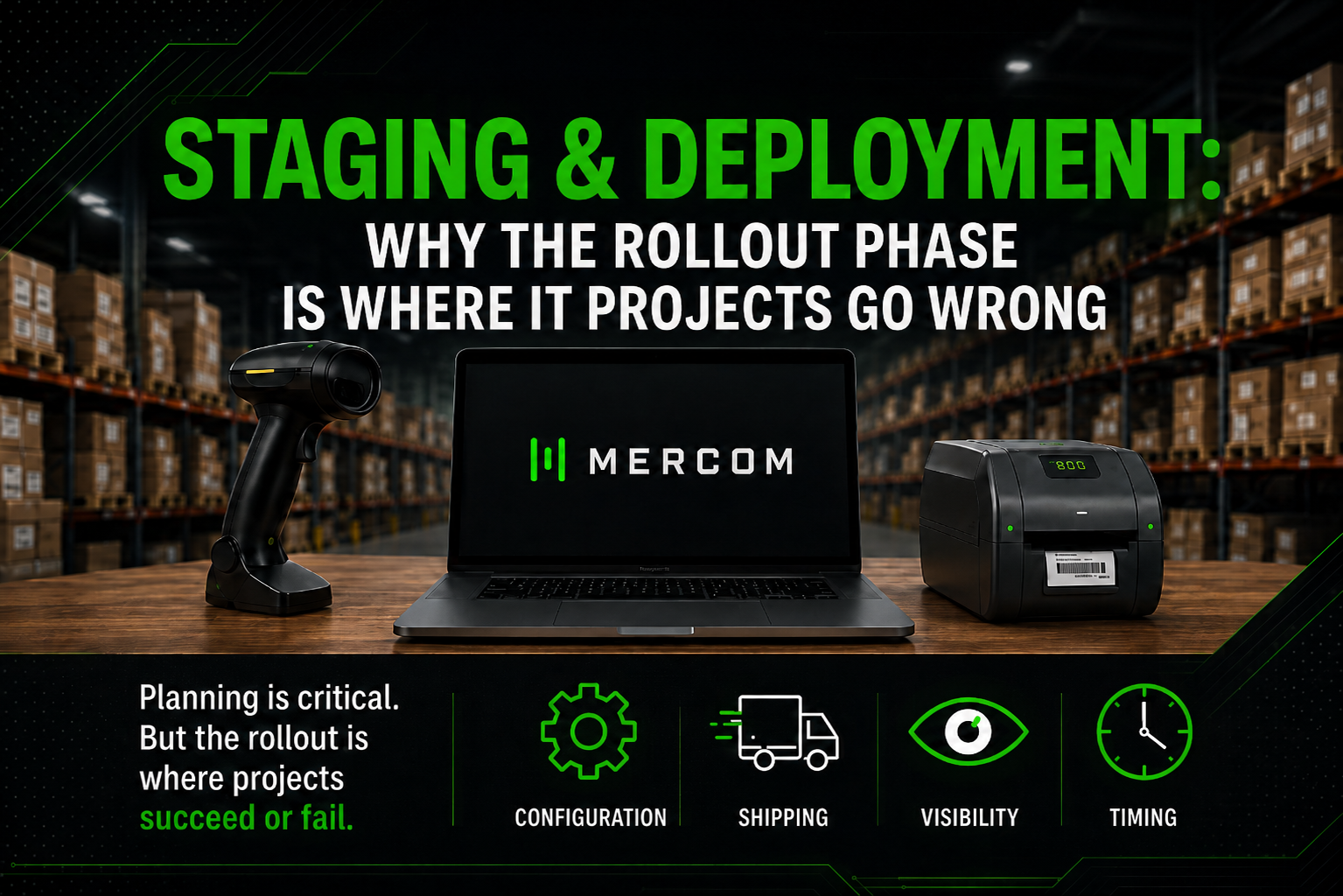
Here's why the rollout phase is where IT projects go wrong, and what it takes to get it right.
The Gap Between "Delivered" and "Ready to Use"
There's a dangerous assumption built into many rollout plans: that hardware straight from the manufacturer is ready to hand to employees. It's not.
Many devices need to be configured. Software needs to be loaded. Security protocols need to be applied. Each unit needs to be tested, both before and after configuration, to catch any DOA hardware before it reaches the field. If the devices are going to specific locations, they may need to be configured to those precise locations before they ship.
That's a lot of work. And when you're rolling out anywhere from 100 to 5,000 units across multiple locations, the labor adds up fast. Teams that try to handle this in-house often discover too late that they simply don't have the bandwidth.
Internal IT Gets Overloaded
Your IT department is good at what they do. But staging and deployment at scale is a different kind of work — high-volume, repetitive, time-sensitive, and logistically complex. It pulls your team away from the work they were hired for, and it puts them in a position where one missed step on device 847 can mean a store, warehouse, or clinic location goes live without working equipment.
The bottleneck almost always shows up at the worst possible time: right before launch.
Coordination Breaks Down Across Sites
Multi-site deployments introduce a coordination layer that most internal teams aren't staffed to manage. Getting the right device to the right location at the right time — with the right configuration already on it — requires logistics discipline that goes beyond what most IT departments do day-to-day.
When coordination breaks down, you end up with equipment at the wrong sites, mismatched configurations, or devices sitting idle because shipments arrived out of sequence. Any of these scenarios can delay a go-live date or, worse, push a location to launch on inadequate equipment.
Visibility Disappears Mid-Project
Another common failure point: once equipment leaves the warehouse, nobody knows where it is or when it will arrive. Without regular status reporting built into the process, IT managers are left chasing updates from shipping carriers and fielding anxious calls from location managers.
A well-run deployment should include regular progress reports — ideally daily — so that everyone in the chain knows what has shipped, what's been configured, and what's still in the queue. That kind of visibility is what separates a stressful rollout from a smooth one.
What a Properly Staged Rollout Actually Looks Like
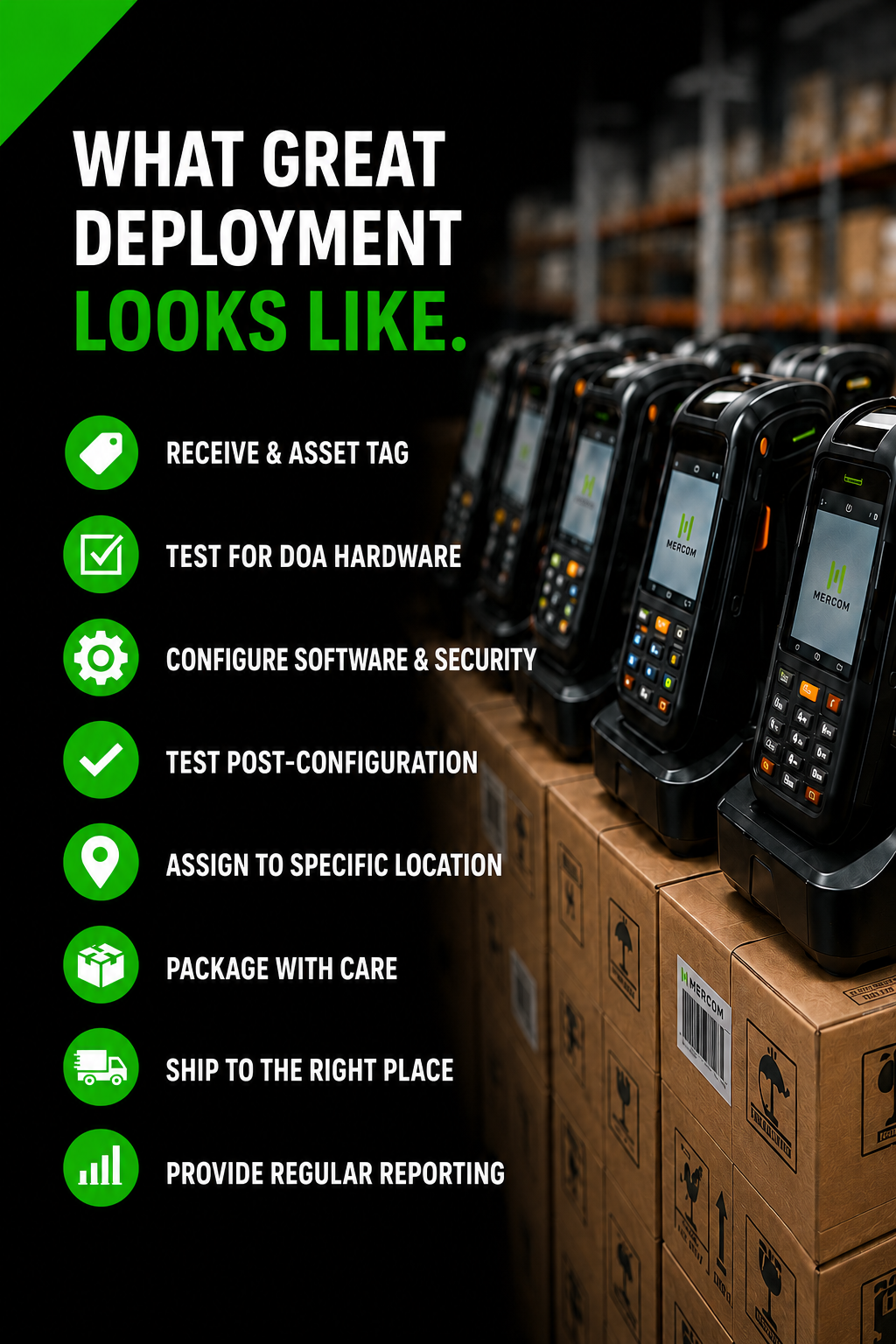
When staging and deployment is handled correctly, the process is methodical and well-documented from start to finish:
- All equipment is received and asset-tagged at a central facility
- Units are tested for DOA hardware before any configuration begins
- Software is loaded, and security protocols are configured on each device
- Devices are tested post-configuration again
- Equipment is configured to the specific location it's being shipped to, where applicable
- Everything is carefully re-packaged and shipped to the right place at the right time
- Regular progress reports keep stakeholders informed throughout
Done this way, employees at each location receive equipment that's ready to go the moment they open the box. There's no waiting for IT to remotely configure devices, no troubleshooting mis-loaded software, and no scrambling to replace DOA hardware at launch.
The Case for Outsourcing Deployment
For many organizations, the cleanest solution is partnering with a third-party provider that specializes in hardware staging and deployment. A dedicated partner brings the warehouse space, staffing, logistics infrastructure, and process discipline that most internal teams simply can't replicate at scale, without pulling your IT staff off their core responsibilities.
It also brings accountability. When deployment is in-house, and something goes wrong, the root cause can be hard to trace. A specialist partner maintains documentation throughout the project and provides reporting that makes it easy to identify the origin of any issue.

Keep Your IT On — At Launch and Beyond
A hardware rollout is one of the highest-stakes projects an IT team undertakes. Devices are the foundation on which everything else runs — mobile devices, barcode hardware, printers, laptops, iPads, and point-of-sale systems. When those devices aren't ready on day one, the impact ripples across the entire operation.
The rollout phase doesn't have to be where projects go wrong. With the right process and the right partner, it can be the phase where everything comes together exactly as planned.
Mercom has been managing hardware staging and deployment for retailers, hospitality chains, healthcare organizations, and warehouse operations for over 25 years. We handle projects from 50 to 5,000+ units and customize every process to fit your schedule and equipment. If you have a rollout coming up, let's talk.