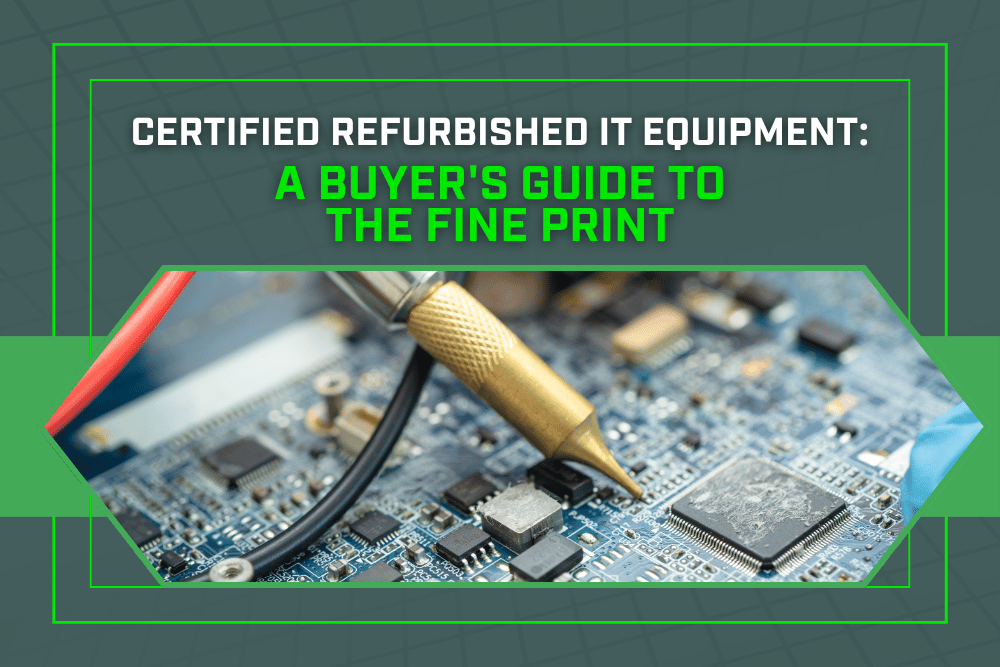
Certified Refurbished IT Equipment: A Buyer's Guide to the Fine Print
September 17, 2026
"Refurbished," "renewed," "open-box," "certified refurbished." Search for used IT equipment for more than five minutes, and you'll run into all four terms, often on the same listing page, sometimes describing the exact same device. Sellers use them almost interchangeably, but they don't mean the same thing, and if you're outfitting a fleet of barcode scanners, printers, mobile devices, or POS terminals, that gap matters more than the price tag does.
Here's the short version: "certified" is the only one of these words that's supposed to come with proof.
Not All "Used" Is the Same
Some sellers wipe a device, snap a few photos, and list it. Others tear the unit down, test every component, swap out anything that's worn, and put a warranty behind it before it ever goes back on the shelf. Both of those get sold under the same "refurbished" umbrella, which is a big part of why procurement teams get burned and then swear off refurbished equipment entirely, even when a properly certified option would have saved them money without adding risk.
That's the gap "certified" is supposed to close. When a manufacturer or a legitimate third-party repair shop certifies a refurbished unit, they're saying it went through an actual process, not just a wipe-down and a reboot.
So What Does "Certified" Actually Cover?
A device that's genuinely certified refurbished has usually been through something like this before it ships:
- Diagnostic testing on every major component: circuit boards, battery, screen, print head, scan engine, Bluetooth and Wi-FI connections. Powering on and confirming it boots isn't a diagnostic. It's a formality.
- Refurbishment and part swaps using OEM or OEM-equivalent components, so a device with a failing battery doesn't just get sold with a failing battery.
- Software updates: load the latest OS and firmware updates onto each device.
- A grading system that tells you the unit's actual cosmetic and functional condition, instead of a marketing label like "like new."
- A warranty. This is what separates a certified refurbished device from something a reseller listed on their own. If a seller is willing to warranty it, they're telling you they trust their own testing.
Skip any one of those steps, and you don't really have a certified device. You have used equipment that you may not be able to depend on.
At Mercom, we warranty refurbished hardware for one year, which matches many manufacturer warranties.
Certified Refurbished vs. "Open-Box" and "Like New"
Open-box usually just means someone returned it. It might work fine. It might have failing components, or a battery that's already lost 20% of its capacity, and you won't know until it's in your hands. "Like new" describes how something looks, not how it performs. Neither term obligates you to test it or stand behind it afterward. Certified refurbished is the only one of these categories where accountability is part of the definition, which is why it's worth asking for by that exact name and not settling for a softer synonym.
Why This Actually Affects Your Bottom Line
If you're running IT hardware across multiple retail locations, warehouses, a fleet of trucks, or hospitality properties, a single bad unit isn't really a single-unit problem. A scanner that dies mid-shift or a printer that goes down during your busiest week costs far more than the hardware replacement itself.
Certified refurbished buys you a few things at once when done right. You get equipment at a fraction of new pricing, without gambling on reliability, because the testing already happened before you bought it. You can scale a fleet faster, since certified inventory is often easier to source in volume than waiting on new manufacturer lead times. You get a sustainability angle you can document, because extending a device's usable life reduces e-waste in a way you can point to, not just claim. And if your provider also handles repair and advance exchange after the sale, that equipment stays supported long after the invoice is paid.
Questions Worth Asking Before You Consider Refurbished Equipment
Get straight answers on a few things before you consider a refurbished order:
- What testing protocol does each unit actually go through, and against what standard?
- Are the replacement parts OEM or OEM-equivalent?
- What does the warranty cover, and for how long?
- Can they hand you grading documentation for the units in your order?
- And once the sale is done, is there any repair or exchange support left, or are you on your own?
If a seller hedges on more than one of those, "certified" is doing a lot of marketing work it hasn't earned.
Bottom Line
Certified refurbished should mean something you can verify: tested, repaired, graded, and backed by a warranty. When it does, it's one of the smarter ways to keep a hardware fleet running without paying full price for every unit. That's the standard we hold our own certified refurbished equipment to at Mercom, because Keeping Your IT On means we're still standing behind a device long after it leaves our facility, not just while it's still in the box.
Ready to see what a properly certified refurbished device looks like? We’d love to talk.
Frequently Asked Questions
What does "certified refurbished" mean for IT equipment?
It means the device was diagnostically tested, had any worn or failing parts repaired or replaced with OEM or OEM-equivalent components, was graded for condition, and is backed by a warranty. If any of those steps are missing, the device isn't truly certified; it's just used.
Is certified refurbished the same as used equipment?
No. All certified refurbished equipment is technically "used," but not all used equipment is certified. Certification proves the device was tested and repaired to a defined standard, rather than just resold as-is.
How is certified refurbished different from open-box?
Open-box typically means a device was returned with little to no use and resold without diagnostic testing. Certified refurbished always includes testing, repair, and a warranty. Open-box may or may not include any of those.
Does certified refurbished equipment come with a warranty?
Yes, when it's genuinely certified. A warranty is a core requirement of certification. If a seller won't back a "certified" device with a warranty, treat the certification claim with caution.
Are the replacement parts in certified refurbished devices OEM?
They should be OEM or OEM-equivalent. Reputable refurbishers replace worn components with parts that meet manufacturer specifications rather than lower-quality substitutes.
Is certified refurbished IT equipment reliable enough for business use?
Yes, when it's sourced from a provider that tests and warranties its inventory. Certified refurbished devices undergo the same diagnostic scrutiny as new equipment, which makes them a lower-risk option than uncertified used hardware.
What should I ask a seller before buying certified refurbished equipment?
Ask what testing standard they use, whether replacement parts are OEM or OEM-equivalent, what the warranty covers, whether they can provide grading documentation, and whether repair or advance exchange support is available after the sale.